Most social impact organizations doing the hardest work in the world have already figured out what works. They have years of evidence, real users, and data on what their intervention actually does in the field. What they're building toward is reach — more communities, more impact, with the same team.
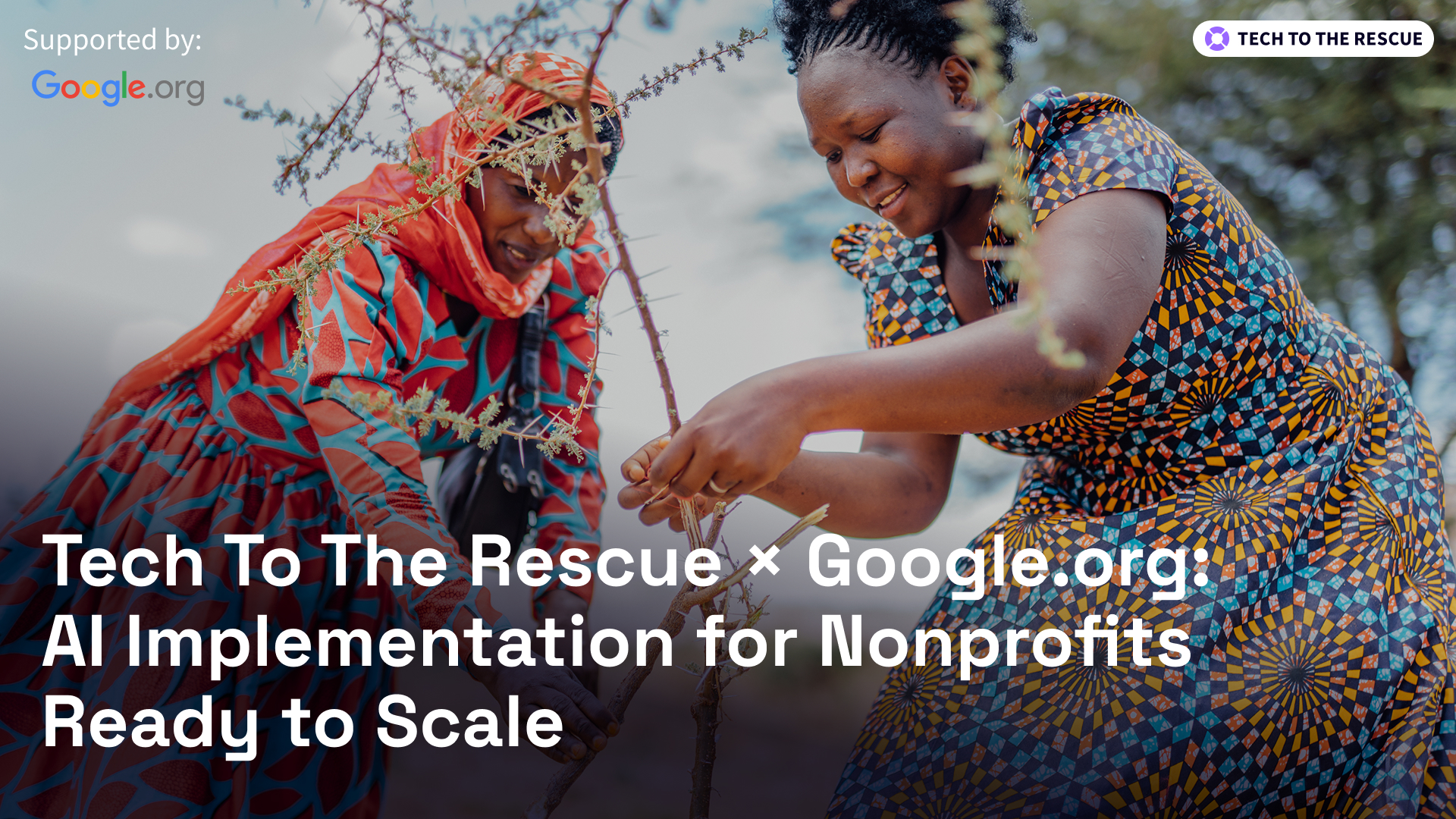
Starting August, the next cohort of the AI Impact Scaling Program is supported by Google.org.
Fifteen social impact organizations identified through Google.org's Skills-Based Volunteering Fellowship and Tech To The Rescue's network will spend twelve months inside Tech To The Rescue's AI enablement ecosystem: working alongside a dedicated pro bono tech team, with specialized support in data readiness, cybersecurity, and responsible AI, and a peer community of over 50 organizations that have been through the same process.
Over twelve months, each organization gets three things working in parallel.
A dedicated Pro Bono tech team.
We spend weeks, sometimes months, on each match. We look for a team with the exact expertise the project needs, from a network of 2,000+ companies. They build alongside the organization for two to six months, with Tech To The Rescue providing active oversight throughout.
Specialized support.
On-demand access to AI experts in data readiness, cybersecurity, and responsible AI. This matters because the problems that derail AI projects in the social sector are rarely the ones that appear in a proposal. They show up once building starts.
A peer community.
Fifteen organizations working on completely different problems in completely different contexts, all asking the same question: how do you take something that works and make it work at scale. We've seen organizations in this program change their entire approach to data governance based on a conversation with another cohort member. That's not incidental. That's part of how implementation actually happens.
Google.org's Skills-Based Volunteering Fellowship works with social impact organizations running proven interventions at scale. Each organization referred by the Fellowship had already demonstrated real outcomes — not a pilot, not a prototype, but a working solution with users, evidence, and a specific technical problem that AI can help solve next. Organizations in the program don't need a finished AI product. They need a proven intervention, a specific bottleneck, and one person inside the organization with enough time to drive the project forward.
HDX Signals monitors humanitarian crises across 70+ countries, flagging shifts in displacement, food security, and conflict for responders who use it to inform real funding decisions. The platform has 5.8M unique users. The team is building an LLM layer that compresses an 8-hour manual analysis task to roughly 10 minutes.
ARMMAN's multilingual WhatsApp assistant gives frontline nurse midwives real-time, protocol-aligned guidance on high-risk pregnancies. Live across 4 states with ~9,000 nurses and 45,000+ queries processed. The team is building personalization and multilingual scaling infrastructure to reach 50,000+ nurses across 6 languages.
AI Class ASEAN has certified 430,167 learners and trained 4,966 Master Trainers in AI literacy across 11 countries. The team is building personalization and learning analytics on top of their existing platform to deepen outcomes without adding instructor headcount.
A spin-off of the Technical University of Munich, Mevidence is building a fact-checked AI assistant that gives cancer patients reliable guidance on therapies, follow-up care, and side-effect management. Currently in beta with 3 institutions, the team is expanding to multilingual support and a broader NGO partner network.
Reboot Education is a teacher resource platform for sustainability and climate education with 22,000 unique users. Their AI classification pipeline already cuts manual tagging from 2 hours to 5 minutes. The team is extending that pipeline and building personalization to scale content to 100,000+ teachers.
StretchAI is a research-grounded AI coaching tool for educators, live to 20,000 ISTE members. The team is building an insights engine that surfaces patterns from educator conversations and improves answer quality at scale — without proportional staff growth.
Kiron's THRIVE program upskills refugee and migrant women through a custom Learning Hub, with an 800-person waiting list. The team is building an AI Career Companion providing always-on job search and labor market navigation support, decoupling learner growth from staff capacity.
Mirror is a clinically-backed journaling app for adolescents with 200,000+ downloads and 12,800 monthly active users, with a safety system that routes at-risk users to crisis support. The team is building a longitudinal layer that detects worsening mental health trajectories across journal entries over time.
Networks for Humanity operates open transaction networks connecting 750K+ sellers, 800K+ farmers, and powering 156M+ mobility trips. The team is building AI-assisted onboarding automation that collapses the process of joining a network from months to minutes.
One Degree helps families navigate social services — food, housing, healthcare, childcare — with a 69% closed-loop referral completion rate versus 9–20% for traditional systems and $37.7M in services unlocked in 2024–25. The team is building an AI enrollment engine that automates eligibility screening and application completion across fragmented government systems.
SukhaRakshak AI delivers personalized, multilingual drought advisories to farmers via voice, built on a monitoring system operational since 2014 across 8 South Asian countries. With ~50,000 farmers reached in pilots, the team is improving the platform architecture to reach 1 million farmers within 12 months.
The foundation has observed Polish elections for eight years and identified electoral commission training as the weakest link — state training has run on the same 176-slide presentation for 11 years. They are building an AI tool that generates persona-specific training materials and quiz questions from public regulatory text, with expert review built in, targeting the October 2027 elections.
Klub Jagielloński monitors Poland's legislative consultation system, tracing which public comments actually shape legislation. The team is building automated processing of consultation submissions — OCR of scanned PDFs, synthesis of debate positions, and semantic matching of arguments against successive bill versions — cutting analysis time from four days to four hours.
Czulent monitors 200,000–500,000 public posts a month tracking hate speech, extremist narratives, and coordinated disinformation. The team is building an AI triage layer that moves from keyword matching to LLM context analysis, automatically categorizing high-risk cases and structuring evidence for expert review and legal action.
On September 23, the cohort comes together for Matching Day — a global online event where organizations and tech teams from Tech To The Rescue's network of 2,000+ companies meet, explore projects, and start the conversations that lead to a match.
We will document what we learn from this cohort the same way we've documented every one before it: with the things that didn't work alongside the things that did.
Learn more about the program: techtotherescue.org/AI-Impact-Scaling-Program.